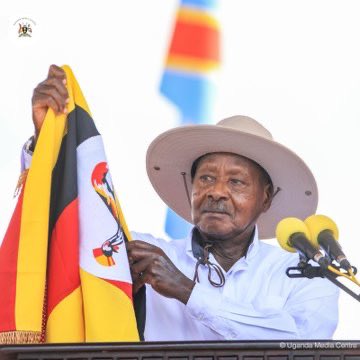
A day after President Museveni took oath of office at Kololo Independence Grounds, analysts have outlined some of the challenges that await him in the new term.
President Museveni who was sworn-in yesterday for a record seventh consecutive term following his landslide victory in disputed elections in January, extending his tenure as one of Africa’s longest serving rulers.
This followed his overwhelming victory in the January 15th elections. The Electoral Commission declared president Museveni winner of the January 15th elections with over 7.9 million votes, representing 71.6% of the total votes cast, against his closest challenger, the opposition National Unity Platform candidate, Mr. Robert Kyagulanyi’s 2.7 million votes, accounting for 24.7%.
In his inaugural speech, Museveni termed it Kisanja “no more sleep for all Ugandans”
“This “Kisanja’’ Term should be regarded as Kisanja of no more sleep for all Ugandans”, Museveni said.
However, according to Mr.Crispin Kaheru, a member of the Uganda Human Rights Commission and political analyst, Uganda needs more than just themes.
“The election gave him a mandate. That legitimacy must now be deepened through performance, efficiency, discipline and national inclusion”, he said.
Mr.Kaheru said that what awaits president Museveni in his seventh term is ultimately a test of legacy, emphasizing that while the country has peace, infrastructure and oil prospects, what the citizens want now are jobs, cheaper credit, better service delivery, less corruption, and a State that works faster.
Mr. Kaheru says the president’s biggest domestic challenge will be economic impatience.
“Young people no longer judge government only by the history of 1986 and what came before; they judge it by present opportunities. The next term must therefore be less about explaining achievements and more about converting them into incomes that reach the pockets of ordinary Ugandans”, he said in a statement.
Politically, Mr. Kaheru says, President Museveni will have to manage Cabinet expectations, generational pressure within the National Resistance Movement, and a Parliament where ambition may at times be louder than ideology. After every major victory, the hardest battle is often not against the opposition, but in managing the appetites of friends, allies and power centres within”, Mr. Kaheru explains.
While regarding foreign policy, Kaheru says President Museveni returns to office in a more difficult world. Geopolitics is increasingly transactional. Regional security remains fragile. Uganda must balance relations with the West, China, the Gulf and African neighbours without appearing dependent on any single centre of power.