BY REUTERS
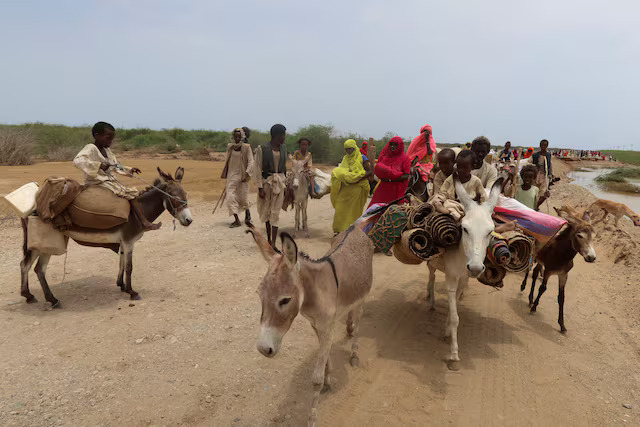
Since floods swept away their home in eastern Sudan, Ahmed Hadab and his family have survived by drinking water mixed in with milk from his last surviving goat.
“We don’t have any food,” he said after days of walking, trying to find something to eat, somewhere else to stay. “The sorghum and flour was taken by the torrent, and two of my goats and my donkey.”
Floodwaters from heavy rains that started surging in earlier this month have brought devastation across a country already shattered by 500 days of fierce fighting between the army and paramilitary Rapid Support Forces.
Now, the natural disaster has spread destruction further than the conflict.
Near the town of Tokar, in the country’s eastern region which has so far escaped the violence, a Reuters reporter saw people pulling each other out of the water onto the remnants of a bridge with ropes.
Elsewhere in the eastern Red Sea State, the Arbaat Dam collapsed on Sunday, threatening the freshwater supply for Port Sudan, the country’s de facto capital, up to now a relative refuge for the government and aid agencies and hundreds of thousands of displaced.
At least 64 people from the area are missing.
Others are stranded on higher ground with no food and little hope of rescue, according to locals. Many hundreds of households are also displaced in Sudan’s Northern State, another region largely untouched by the fighting, according to the United Nations.
In Darfur, where millions are threatened with extreme hunger, the rain has damaged displacement camps and delayed the arrival of crucial aid according to the World Food Programme.
The U.N. estimates that, over all, more than 300,000 people are impacted by the flooding. It has brought cholera for the second year running with 1,351 cases reported as of Wednesday, likely an undercount as the army-aligned health ministry struggles to access the large portion of the country occupied by the RSF.
Abulgasim Musa, head of Sudan’s Early Warning meteorological unit, said that the extreme rains that have unusually hit desert areas were likely caused by climate change. His unit had warned about them in May, he said.
In the land around Tokar, Mohamed Tahir joined scores of others on the roads.
An underfunded and overstretched aid effort has meant that only a few construction vehicles are dotted around the region helping carry people across the flood water and fixing routes so they can escape.
“Homes are collapsed. There’s some who have been taken by the water and not been found,” Tahir said.
“There are some who have died and they haven’t been buried.”