KAMPALA: The Uganda Parliament’s committee on Presidential Affairs has urged the government through the Office of the Prime Minister, to settle within 60 days, all households moved under the earlier phase who are still owed land or shs10 million beginning with 285 households in Bulambuli and stranded families at Girik.
This is contained in the committee report on the resettlement of landslide-affected persons in the Eastern Elgon sub region presented by the committee Chairperson, Ojara Mapenduzi, the representative of Gulu West Division in Northern Uganda’s Gulu District during Thursday’s plenary sitting.
Mr Mapenduzi noted that during their investigations they discovered that only a small fraction of the households at risk had been resettled.
The Committee also recommended that the Office of the Prime Minister tables a single reconciled statement of all funds received for Elgon resettlement for FY 2024/2025 and FY 2025/2026, showing details of the amounts committed, spent and unspent by phase and district.
This was after the Committee found that in every district it visited, households had been moved to holding grounds before their land, cash or basic services were ready, and that many were left there for long periods without support.
This development comes on the heels of a petition to the United Nations Human Rights Council (UNHRC) by survivors of the 2019 landslides that killed more than 50 people, over their relocation and compensation.
The 48 complainants accuse the government of violating Uganda’s constitution by failing to put effective disaster management measures in Bududa, a mountainous district prone to landslides.
Their case comes as heavy rains raise the risk of further landslides. They say the government relocation programme ignores their safety, land rights and livelihoods.
According to the BBC, the UNHRC is now “considering what is believed to be the first case seeking climate adaptation measures, one that could set a global precedent”.
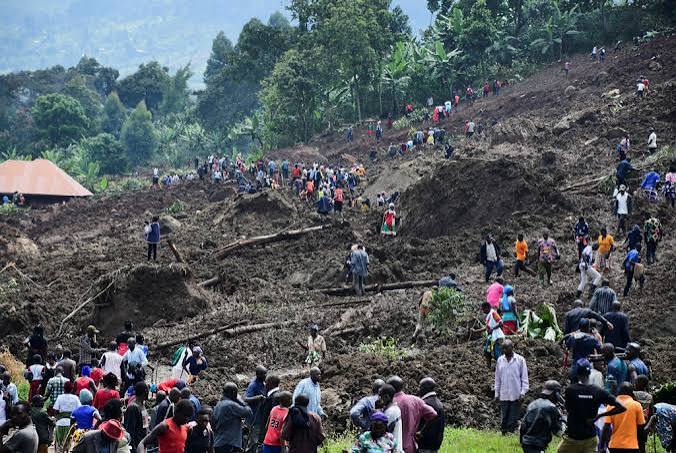
At least 33 of the 53 people who died in the 2019 landslide were children. Years later, survivors say every spell of heavy rain brings back fears of another tragedy.
The BBC reports that William Tsama, one of the claimants, lost four members of his family.
Victims in such situations, ignored by governments, can take them to court to compel them to help their citizens.” Uganda introduced a resettlement plan for landslide-prone areas in 2011, but progress has been limited, with relatively few people relocated.
Through the Office of the Prime Minister, in October 2026, the Uganda government launched a new resettlement programme using a mix of government-acquired land and cash resettlement. The cash package involves a one-off 18m Ugandan shillings ($4,300; £3,300) resettlement payment per verified household in landslide- prone areas such as Namisindwa, Mbale, Sironko and Bududa. to help them move to safer areas.
But some survivors have questioned whether the amount is enough to cover the cost of relocating and rebuilding their lives.
Under the programme, families can choose between receiving two acres of land, valued at 8m shillings, plus 10m shillings towards building a house, or taking the equivalent land allowance in cash, alongside the same housing grant.
The scheme is expected to benefit 1,410 households identified as living in high-risk areas.
The government has now given residents of designated high-risk areas two months, from November to December, to leave or face forced eviction.
The threat extends beyond landslides. The complainants say changing rainfall patterns and declining soil fertility have also affected farming, leaving many families struggling to secure their livelihoods. “I want to get a new good place for my people, so even if I die, they will be okay. I am an old man, but I am doing it for my children,” Tsama said.
The survivors first launched legal action in 2020 in Uganda, and received support from Ugandan environmental organisation Greenwatch three years later.
They are seeking compensation for lost family members and livelihoods, as well as emergency measures, including accessible early-warning systems in high-risk areas.
Greenwatch Executive Director Samantha Atukunda Kakuru Mwesigwa said the case is about changing how governments prepare and respond to climate-related disasters.
“Justice for claimants is not just about winning in court. It is about forcing government policy to keep pace with a changing climate, and ensuring loss and damage is no longer an afterthought in disaster management,” she said.
The threat of climate-related disasters extends across East Africa, claiming the lives of over 180 people between March and May 2024, according to the Kenya Red Cross. While in Rwanda, floods and landslides killed 135 people in May 2023.
The dangers are also being felt further afield. In October 2026, a flash flood swept through Nepal’s Gorkha district after a landslide blocked a river, washing away homes and infrastructure, and killing over 1,500 people.